Models in motion

Research samples

Visual research notes drawn from published applications of energy-based learning, physics-informed deep collocation, transfer learning, and stochastic computation in Xiaoying Zhuang's research.

01 / Variational PDE learning

Energy approach to computational mechanics

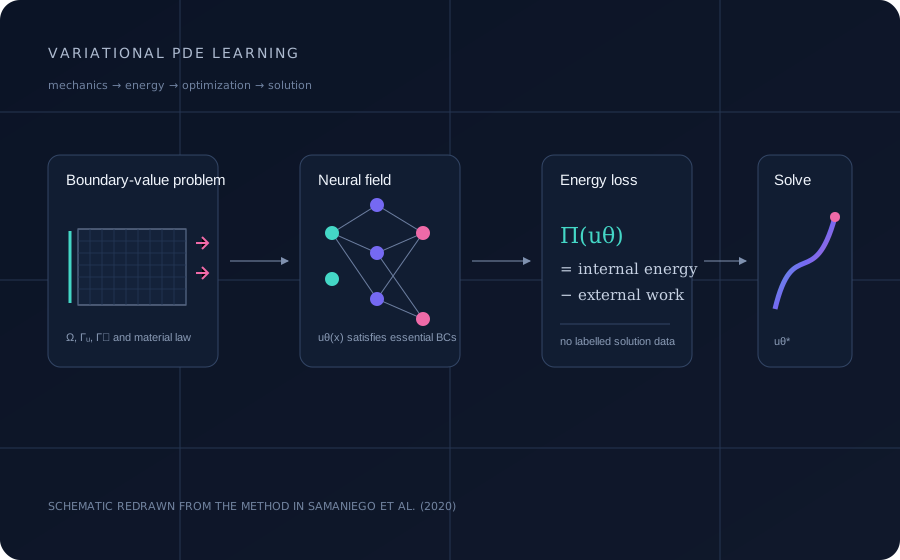
A mechanics-informed framework uses variational energy principles to define neural-network objectives for partial differential equations.

  • Connects weak and variational formulations with machine learning
  • Provides concepts, implementation details, and benchmark applications
  • Uses physical energy rather than labelled solutions as the central objective
Read the paper ↗
Variational PDE workflow from a boundary-value problem through a neural displacement field and total potential energy minimization to the learned solution.
Method map · original redrawBased on Samaniego et al. (2020), DOI 10.1016/j.cma.2019.112790.

02 / Thin-plate mechanics

Deep collocation for Kirchhoff plates

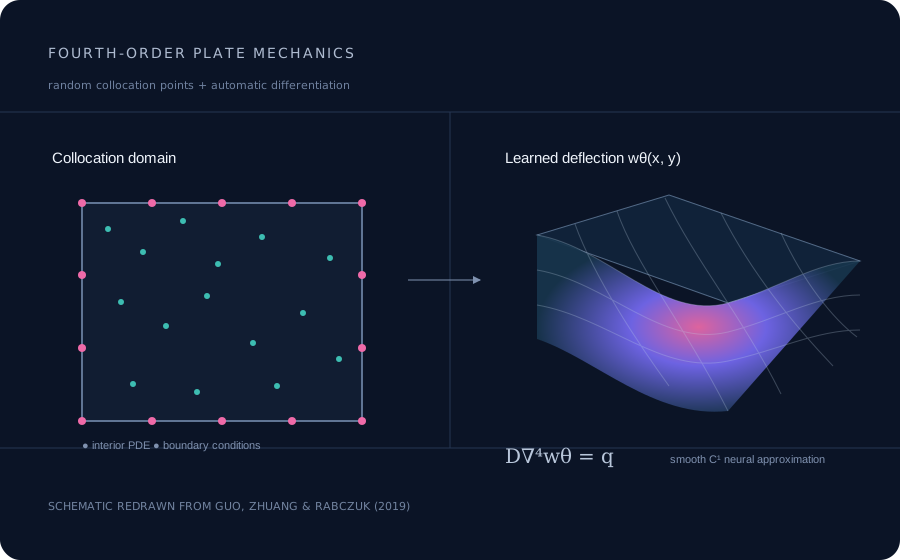
A deep collocation method solves fourth-order Kirchhoff plate bending by embedding the governing equation and boundary conditions into the training loss.

  • Mesh-free neural approximation of plate deflection
  • Physics and boundary constraints enforced at collocation points
  • Demonstrates deep learning for higher-order structural PDEs
Read the paper ↗
Random interior and boundary collocation points on a square plate alongside a smooth learned plate-deflection surface.
Problem + field view · original redrawBased on Guo, Zhuang & Rabczuk (2019), DOI 10.32604/cmc.2019.06660.

03 / Non-homogeneous media

3D potential problems with material transfer

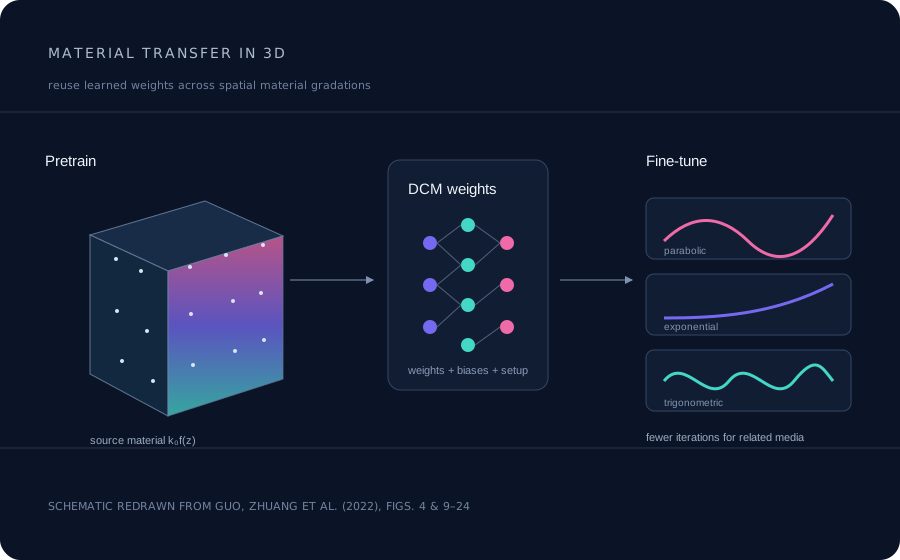
Physics-informed deep collocation addresses three-dimensional potential equations with spatially varying material properties, supported by material transfer learning and global sensitivity analysis.

  • Tests activation, sampling, and optimizer configurations
  • Transfers across material gradations and parameters
  • Includes global sensitivity analysis and convergence analysis
Read the paper ↗
A three-dimensional graded material model is pretrained, its deep-collocation weights are retained, and the model is fine-tuned for parabolic, exponential, and trigonometric material variations.
Transfer-learning map · original redrawBased on Guo, Zhuang et al. (2022), Figs. 4 and 9–24, DOI 10.1007/s00366-022-01633-6.

04 / Stochastic porous media

Architecture-searched deep collocation

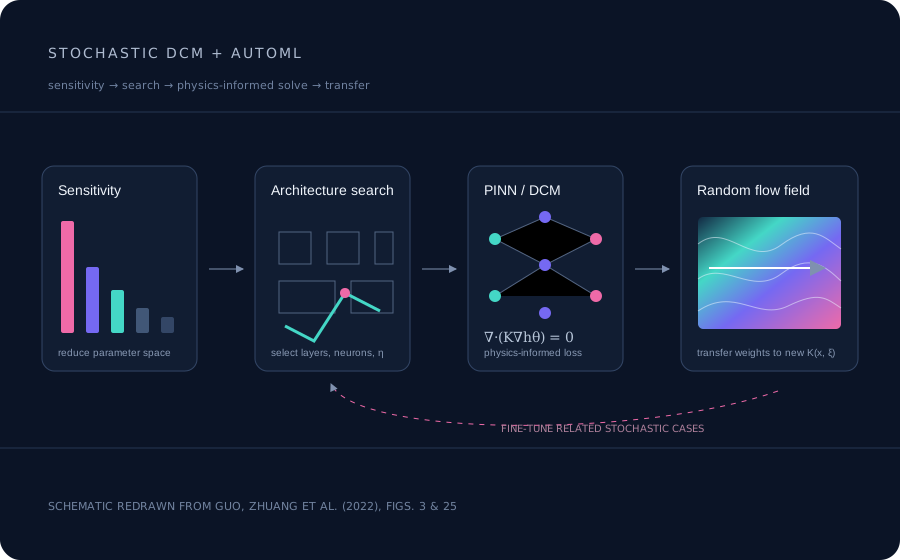
A stochastic DCM combines sensitivity analysis, neural architecture search, and transfer learning for highly heterogeneous three-dimensional groundwater flow.

  • Sensitivity analysis narrows the hyperparameter search space
  • Strong architectures supply weights for efficient fine-tuning
  • Validated across dimensions with manufactured solutions
Read the paper ↗
Sensitivity analysis narrows an architecture search, which selects a physics-informed network to solve random groundwater-flow fields and transfer to related conductivity cases.
End-to-end model · original redrawBased on Guo, Zhuang et al. (2022), Figs. 3 and 25, DOI 10.1007/s00366-021-01586-2.